white flight
The Short and Tragic Life of Robert Peacewhite flight is presented not as a single departure but as a cumulative urban transformation: after the 1967 Newark riots, white residents increasingly left neighborhoods they associated with racial unrest, while real-estate practices and new transportation corridors made that departure easier and more profitable. Its consequences reshaped East Orange and the surrounding Oranges, helping establish the social landscape through which Rob Peace and Jackie Peace moved.
Historical Setting
The background to white flight is the 1967 Newark uprising, which followed the alleged police beating of a black cabdriver and lasted five days. Burning, looting, sniper fire, and rage left twenty-six people dead, more than seven hundred injured, and fifteen hundred arrested. Jackie Peace and her girlfriends tried to approach the city to see the upheaval for themselves, but National Guardsmen stopped them at a checkpoint. The riots permanently altered the city’s texture, and racial identity increasingly displaced older definitions based on factories, occupations, and the countries from which immigrants’ grandparents had come.
Highways and Real Estate
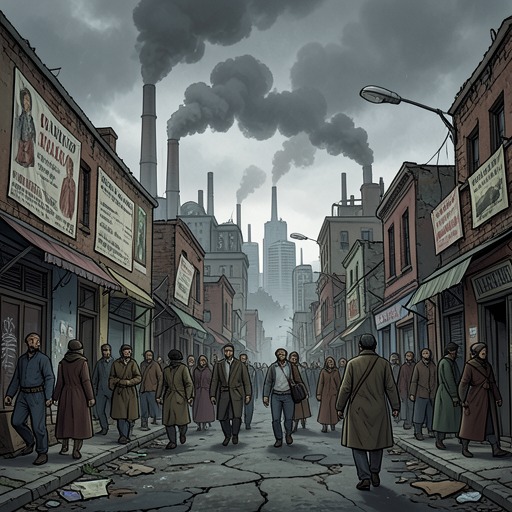
Jackie first observed white flight indirectly while riding the bus to her first job after high school in the mail room of Orange City Hall. Blocks that had once appeared settled were marked by clusters of “FOR SALE” signs, sometimes three or four on a single block. In 1973, the western spur of Interstate 280 was completed beneath the Oranges, only four blocks north of Chapman Street. By connecting downtown Newark with suburban enclaves in Morris County and the Watchung Mountains, the freeway reduced journeys that had taken more than an hour on Central Avenue to roughly fifteen minutes. It thus supplied a fast corridor for residents who felt threatened or uncomfortable near the city’s impoverished neighborhoods, allowing them to pass through those areas at highway speed rather than remain part of them.
Horace Peace spoke contemptuously of the real-estate market that accompanied this movement. Realtors exploited civic unrest by telling white homeowners that one black family on a block would be followed by others and that property values would fall if the homeowners stayed. Jackie noticed the resulting change gradually, more as a persistent impression than as a set of statistics: Vailsburg, Irvington, and East Orange became “blacker,” house by house and block by block, as the demographic shift moved west from downtown Newark.
Demographic and Economic Consequences
The numerical transformation of East Orange makes the process visible. In 1960, when Jackie’s family moved from Elizabeth, the city was 39 percent black and 53 percent white. By 1980, the year Rob Peace was born, it was 89 percent black and 4 percent white, and the area was known colloquially as “Illtown.” Jackie was not then analyzing demographic change as a political phenomenon; she was trying to keep a job when one was available and help pay for ordinary pleasures. The statistics nevertheless describe the environment in which her son would grow up.
White flight unfolded alongside deindustrialization. Factories across Newark and other port cities moved toward cheaper land outside urban centers as transportation improved, while Japan and China exported less expensive goods and American companies outsourced labor overseas. Tanneries, glass and plastics plants, and manufacturers of industrial machine parts closed one after another; more than six hundred factories in and around Newark had once helped make its port the nation’s busiest. Their disappearance brought massive layoffs and removed the industrial foundation that had previously organized neighborhoods and sustained working families. Racial relocation and economic contraction therefore reinforced one another: white residents departed, factories disappeared, and the communities that remained inherited a city with fewer jobs and fewer stable routes to advancement.
Narrative Significance
The expression gives the book a structural explanation for conditions that might otherwise look like individual failure. Jackie’s later decision to protect Rob from public schooling emerges within a landscape already marked by racial segregation, economic abandonment, and diminished expectations. When she returned to Orange High decades after attending it herself and saw students gathering amid graffiti and apparent disorder, she read the school as preparing many of them for lives as loiterers, hustlers, and single mothers. Her sacrifice was a response to the narrowed social world produced by these wider changes: she believed Rob could leave Orange spectacularly even though she understood that she herself had become part of its asphalt fabric.
The effects of white flight also persist in Rob’s divided existence. In Newark and East Orange, he and Victor Raymond had to appear fully at home in the streets while commuting through a neighborhood where they were mugged three times during middle school. Rob distributed money through his socks, back pockets, and underwear, carried his schoolbag as proof that he was going to or from class, and learned to adjust his speech and behavior between ideal student, neighborhood provider, and corner kid. Years later at Yale, black students had to locate themselves within a racial order that their white classmates often treated as invisible; Rob, both black and poor, was part of a small minority within Yale’s black student population. white flight therefore names more than a population shift. It helps explain the racialized geography, class pressure, and repeated identity calibrations that the narrative follows from the Oranges to the university and back.
Social and Institutional Afterlife
The consequences of white flight extended beyond who lived on which block. As racial identity replaced older neighborhood identities rooted in factories, occupations, and immigrant origins, the remaining communities were increasingly interpreted through racialized assumptions rather than through the economic forces that had transformed them. This shift forms the background to Jackie Peace’s alarm when Rob Peace described extensive drug dealing at Oakdale Elementary School. She briefly imagined sending him to Orange High, the school she had attended, but a visit during the school day changed that possibility. Standing on South Orange Avenue and looking at graffiti-covered walls, crowded steps, windows, and a yellowed lawn, she imagined the students being trained not for college or employment but for lives as loiterers, hustlers, and single mothers. Her response was not simply an individual preference for private education; it was an attempt to route her son around a public landscape she understood as the accumulated result of racial conflict, disinvestment, and shrinking opportunity. Rob’s movement through that landscape required an equally persistent negotiation of belonging. During middle school, he and Victor Raymond were mugged three times, concealed money in socks, back pockets, and underwear, and kept only a few dollars in their wallets so they could surrender them if stopped. Rob’s worn schoolbag signaled that he was traveling to or from class, while his speech, football, music, and insistence on being known as Skeet Douglas’s son made him legible as part of the neighborhood. The expression white flight thus names a demographic process whose afterlife appears in school choices, street safety, racial self-presentation, and the unequal burden placed on children who had to become socially fluent in both institutional and street worlds.
Institutional and Personal Afterlife
The consequences of white flight extended beyond who lived on which block. As racial identity replaced older neighborhood identities rooted in factories, occupations, and immigrant origins, the communities that remained were increasingly interpreted through racialized assumptions rather than through the economic forces that had transformed them. This shift forms the background to Jackie Peace’s alarm when Rob Peace described extensive drug dealing at Oakdale Elementary School. She briefly imagined sending him to Orange High, the school she had attended, but a visit during the school day changed that possibility. Standing on South Orange Avenue and looking at graffiti-covered walls, crowded steps, windows, and a yellowed lawn, she imagined the students being trained not for college or employment but for lives as loiterers, hustlers, and single mothers. Her response was not simply an individual preference for private education; it was an attempt to route her son around a public landscape she understood as the accumulated result of racial conflict, disinvestment, and shrinking opportunity.
Rob’s movement through that landscape required an equally persistent negotiation of belonging. During middle school, he and Victor Raymond were mugged three times, concealed money in socks, back pockets, and underwear, and kept only a few dollars in their wallets so they could surrender them if stopped. Their schoolbags signaled that they were traveling to or from class, while Rob’s speech, football, music, and insistence on being known as Skeet Douglas’s son made him legible as part of the neighborhood. The same adaptive skill later appeared at Yale, where he moved quietly through a predominantly white institution while remaining one of the few black students who had grown up at or below the poverty line. White flight thus names a demographic process whose afterlife appears in school choices, street safety, racial self-presentation, and the unequal burden placed on children who had to become socially fluent in both institutional and street worlds.